Key takeaways
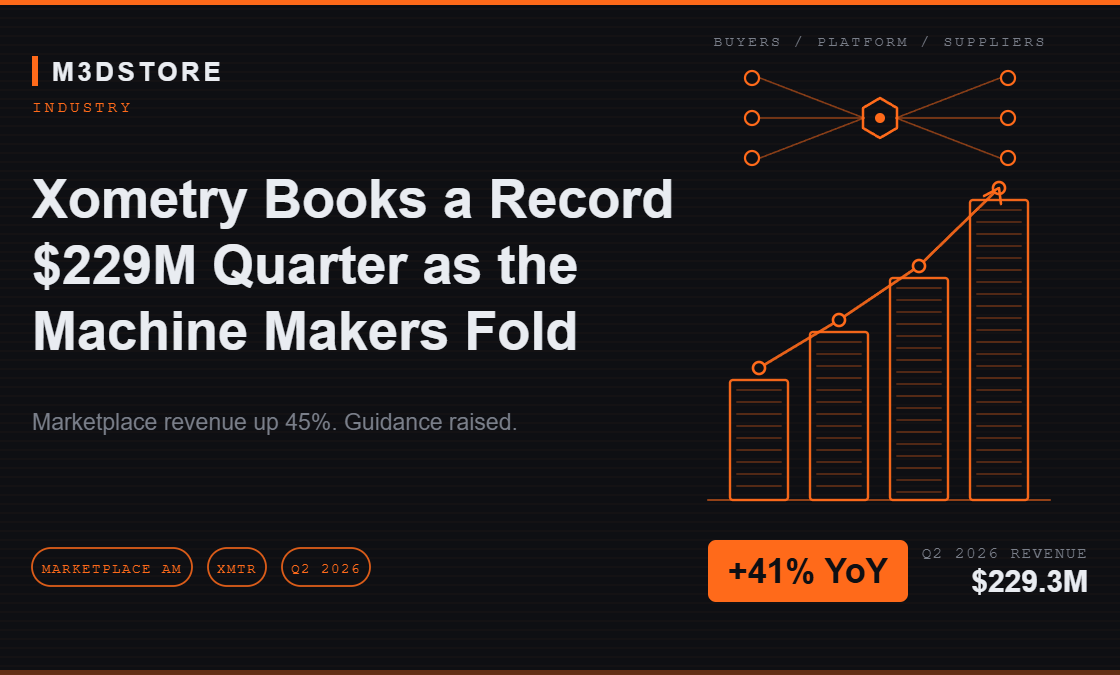
- Xometry posted record Q2 2026 revenue of $229.3 million on 4 August, up 41% year over year — well ahead of the roughly $213–215 million analysts had penciled in.
- Marketplace revenue grew 45% to $215.4 million, the fourth consecutive quarter of accelerating top-line growth.
- The company is close to real profitability: adjusted EBITDA hit $14.1 million (a 6.2% margin, up 380 basis points), and net loss narrowed to $5.3 million.
- Full-year guidance went up, not down — Xometry now expects 2026 revenue growth of 33–34%, raised from 27–28%.
- The timing is the story. This lands the same week 3DEO entered insolvency and BigRep SE went into liquidation. Money in additive is flowing to the layer that sells parts, not the layer that sells machines.
Xometry (NASDAQ: XMTR) reported its second-quarter 2026 results on 4 August, and the numbers were the best in the company’s history. Revenue reached $229.3 million, a 41% jump on the $162.5 million it booked in Q2 2025, according to the company’s official results release. Gross profit rose 34% to a record $87.2 million.
For a sector that has spent two years absorbing shutdowns, delistings and fire-sale acquisitions, a 41% growth quarter is an unusual headline. What makes it worth reading closely is where the growth came from.
The marketplace is doing all the work
Xometry runs two businesses. The marketplace sells parts and assemblies — CNC machining, sheet metal, injection molding and 3D printing — sourced from a distributed supplier network. Services sells advertising, marketing and SaaS tools to those suppliers.
Only one of them grew. Marketplace revenue hit $215.4 million, up 45%. Services revenue came in at $13.9 million — up slightly sequentially, but down about 3% year over year. That divergence has been widening for a while, and Q2 made it unmistakable: Xometry’s growth engine is transactional part volume, full stop.
The buyer metrics back that up. Active marketplace buyers grew 20%, from 74,777 to 89,557. More importantly, accounts spending at least $50,000 over a trailing twelve months grew 23%, from 1,653 to 2,039. That second number is the one to watch — it means Xometry isn’t just adding hobbyist-scale accounts, it’s capturing production budgets that used to sit with a local job shop.
AI pricing, not AI marketing
Xometry describes itself as an “AI-native marketplace,” which in most press releases means very little. Here it maps to specific plumbing shipped during the quarter: a context-aware process recommender that suggests which of 20 supported manufacturing techniques suits an uploaded part; a new generation of cost-prediction models that price parts on geometry, material, finish and job context; and adaptive sourcing models that score each job against a given supplier’s machine characteristics, quality history and on-time shipping record.
That is the actual moat. Anyone can build an upload-a-STEP-file form. Quoting a part accurately in seconds, and routing it to the one shop in the network most likely to deliver it on time, requires a proprietary data layer built from millions of historical jobs. It’s also why Xometry’s margins are finally moving: better routing means fewer reprints, fewer late deliveries and less margin leakage.
Why it matters: the barbell is getting more extreme
Set this quarter against the rest of the week’s news. 3DEO entered insolvency and put its patents and machinery up for auction. BigRep SE went into liquidation after a SPAC listing that never worked. Fusion3 shut down. We covered that squeeze on Saturday, and it hasn’t let up.
The pattern is a barbell. At one end, capital is piling into the software and demand-aggregation layer — Xometry raised $248 million in a June follow-on offering plus $50 million in a private placement with Siemens, ending Q2 with $517 million in cash and marketable securities. At the other end, cheap, competent hardware from Bambu Lab, Creality and Elegoo keeps eating the low end. What’s collapsing is the middle: mid-priced Western machine builders selling capital equipment to customers who increasingly would rather just buy the part.
If you run a print farm or a small shop, this cuts both ways. Xometry’s supplier network is a genuine demand channel you can plug into without a sales team. It’s also a channel that scores you on quality and on-time delivery and prices your capacity dynamically — which is a polite way of saying the platform, not you, sets the margin.
What Xometry expects next
Guidance moved the right way, which is rare in this sector right now. For Q3 2026, Xometry expects revenue of $234–236 million (30–31% growth) and adjusted EBITDA of $16–17 million, against $6.1 million a year earlier. For the full year, it raised its revenue growth outlook to 33–34%, up from a prior 27–28%, with adjusted EBITDA of $60–62 million versus $18.5 million in 2025.
The caveat worth keeping: Xometry is still GAAP-unprofitable, with a $5.3 million net loss attributable to common stockholders in the quarter. It is closing that gap fast — non-GAAP net income of $9.9 million versus $1.1 million a year ago — but “record quarter” and “profitable company” are still not the same sentence. A 6.2% adjusted EBITDA margin is thin for a business this size, and it depends on the marketplace continuing to compound.
FAQ
Is Xometry profitable?
Not on a GAAP basis. Xometry reported a net loss attributable to common stockholders of $5.3 million in Q2 2026 — an 80% improvement year over year. It was profitable on adjusted measures: $14.1 million adjusted EBITDA and $9.9 million non-GAAP net income.
Is Xometry a 3D printing company?
Not exclusively. It’s a custom manufacturing marketplace covering 20 manufacturing processes, including CNC machining, sheet metal fabrication and injection molding alongside 3D printing. It builds no printers of its own — it routes jobs to a network of supplier shops.
Why is Xometry growing while 3D printer makers are shutting down?
Because it sells parts, not capital equipment. Buying a $150,000 industrial printer is a budget decision that stalls in a tight capex environment; ordering a batch of parts is an operating expense that ships this week. Xometry captures demand that machine vendors can no longer convert into hardware sales.
Can a small print farm sell through Xometry?
Yes — the supplier network is open to small shops, and it now spans 89,557 active buyers. Be aware that jobs are scored and priced algorithmically against your machine capabilities, quality history and on-time shipping record, so consistency matters more than headline capacity.
Related reading
3DEO and Fusion3 Shut Down as the US 3D Printing Middle Collapses · Meshy Raises Nearly $400M at a $1.5B Valuation, the Biggest AI-3D Round Yet
Sources: Xometry Q2 2026 results release (GlobeNewswire); VoxelMatters; Investing.com; 3D Printing Industry on 3DEO’s insolvency.

M3Dstore
Writer at M3D — exploring how 3D printing changes the way we learn, make and live.
Leave a Reply