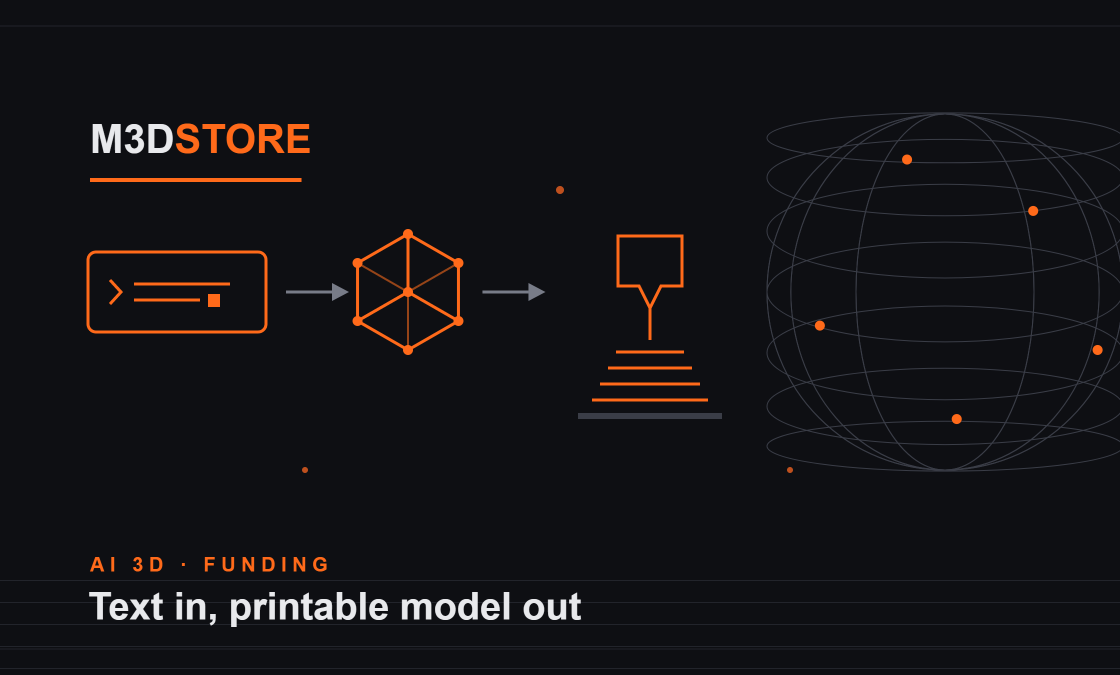
Key takeaways
- Meshy has closed a Series B of nearly $400 million at a $1.5 billion valuation — the largest round to date for a company built specifically around AI 3D generation.
- IDG Capital, Matrix Partners China and Monolith Management led the round, with existing backers Granite Asia, HongShan, BAI Capital and Source Code Capital oversubscribing their allocations.
- Meshy says annual recurring revenue is growing roughly 12x year over year, across more than 12 million registered users and over 100 million models created.
- Its new Meshy 3D Agent turns a conversation, a photo or a sketch into a model exported as FBX, OBJ, GLB or STL — the last of which drops straight into a slicer.
- It is not an isolated bet: Tripo AI raised $150 million in early July, on top of nearly $200 million announced in June.
The hardest part of 3D printing has never been the printer. Machines got cheap, fast and boringly reliable. What stayed hard was the bit nobody sells you at checkout: producing a model in the first place. Investors have now put a very large number on solving that problem.
A record round for AI 3D
Meshy, which builds foundation models for 3D generation, announced it has raised nearly $400 million in a Series B at a $1.5 billion valuation. The company describes it as the largest funding round yet for a business built specifically for AI 3D, a characterisation echoed by 3D Printing Industry and VoxelMatters.
IDG Capital, Matrix Partners China and Monolith Management led. Existing shareholders Granite Asia, HongShan, BAI Capital and Source Code Capital all oversubscribed their allocations — the sort of detail that usually signals a round that was contested rather than shopped.
The traction numbers Meshy put behind it: annual recurring revenue growing about 12x year over year, more than 12 million registered users, and over 100 million models generated to date. Those are company-reported figures rather than audited ones, but the trajectory is consistent with what the round implies.
What the product actually does
The core pitch is simple enough to test in a lunch break: give it one line of text or a single image, and get back a usable 3D model in roughly a minute. Meshy’s models are aimed first at games, where the appetite for cheap asset volume is bottomless, but the company is explicit that the output is increasingly meant to be printable as a physical object too.
That ambition is clearest in Meshy 3D Agent, launched shortly before the round. It takes a conversation, a photo or a rough sketch and produces a model exported in FBX, OBJ, GLB or STL — and STL is the format that matters here, because it is what your slicer eats. The company frames it as requiring no prior 3D experience, which is either the most important sentence in the announcement or the most oversold one, depending on how the meshes hold up.
Why the money is arriving now
Three markets are converging on the same bottleneck. Games need assets faster than artists can model them. E-commerce wants 3D product views at catalogue scale. And consumer 3D printing has a well-documented funnel problem: people buy a printer, print the benchy and the articulated dragon, then stall because they cannot make the specific bracket, jig or replacement clip they actually bought the machine for.
A tool that reliably closes that gap does not just sell subscriptions — it makes every printer already sitting on a desk more useful. That is the thesis a $1.5 billion valuation is underwriting.
The honest caveat
Editorially, we would temper expectations. Generated meshes and print-ready geometry are not the same thing, and the gap shows up in unglamorous places: watertightness, wall thickness, overhang behaviour, tolerances on parts that have to mate with something real. Organic shapes — figurines, props, decorative pieces — are where prompt-to-print already works well. Functional, dimension-critical parts are still CAD’s territory, and no funding round changes that overnight.
The right way to read this news is not that modelling is solved. It is that a great deal of capital now believes it will be, and is buying the runway to try.
Meshy is not alone
Two weeks before Meshy’s announcement, Tripo AI closed a $150 million Series A3, backed by an unusual spread of automotive, gaming and internet strategics including Geely Capital, Giant Network and Fosun Capital. That came on top of nearly $200 million announced a month earlier.
Roughly three quarters of a billion dollars into AI 3D generation inside a single quarter is not a trend line you can wave away as froth. Whether the meshes get good enough to print without cleanup is the open question — and it will be answered in slicers, not in press releases.
FAQ
Can I actually 3D print a model generated by Meshy?
Yes. Meshy 3D Agent exports STL, which slicers accept directly. Expect to run a mesh repair pass and check wall thickness before committing to a long print, particularly on anything with thin features or moving parts.
Does this mean I no longer need to learn CAD?
No. Prompt-to-model is strongest on organic and decorative geometry. Parts that need exact dimensions, threads, press fits or repeatable tolerances are still faster and safer to design in CAD.
Who led Meshy’s Series B?
IDG Capital, Matrix Partners China and Monolith Management, joined by existing shareholders Granite Asia, HongShan, BAI Capital and Source Code Capital, who oversubscribed their allocations.
What does this mean for model repositories like MakerWorld or Printables?
More generated models will land on them. Platforms are already tightening moderation and provenance rules, and a cheaper path to producing uploadable geometry will put more pressure on curation, licensing and duplicate detection.
Related reading
More on the platform side of this: Bambu Lab cleans up MakerWorld in an NSFW crackdown. And if you are still choosing hardware, see our best budget 3D printers for beginners in 2026.

M3Dstore
Writer at M3D — exploring how 3D printing changes the way we learn, make and live.
Leave a Reply