Key takeaways
- Researchers at TU Graz measured a temperature drop of almost 7 °C next to a water-filled, 3D-printed porous ceramic cube during a field test in a hot attic on campus — with no electricity involved.
- The cubes are roughly 23 cm on a side, extruded from a ceramic clay mixture in a triply periodic minimal surface (TPMS) geometry and fired at low temperature to keep them highly porous.
- Physics is old, the geometry is new: capillary action pulls water through the structure and evaporation strips heat from the surrounding air — the same principle as a clay water jug or a wind tower.
- A bio-inspired variant adds fungal cultures and sawdust to the clay; both burn away during firing, leaving a micro- and macro-pore network that moves water more effectively.
- Two demonstration walls are already installed in Graz, and the team is testing dredged lake sediment as a waste-derived feedstock.
Europe is grinding through its fourth major heatwave of the 2026 season, with temperatures above 40 °C logged across the Iberian Peninsula, France, Italy and Austria. Cities take the worst of it — urban heat island effects can push local temperatures 1.7 to 4 °C above surrounding rural areas — and the default answer is air conditioning, which cools one room by dumping heat into the street.
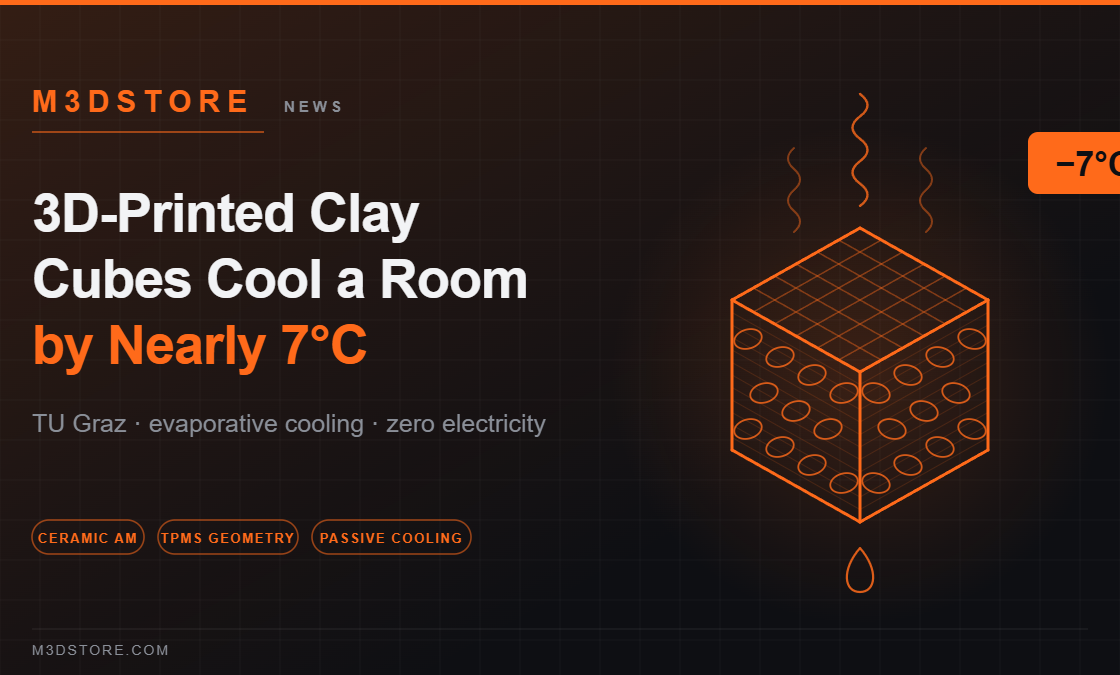
The Institute of Architecture and Media at Graz University of Technology (TU Graz) has been testing a different answer: a wall of 3D-printed porous ceramic cubes that cools by evaporation alone. In a field test reported this week by 3Dnatives and VoxelMatters, one water-filled cube dropped the temperature around it by nearly seven degrees Celsius. No compressor, no refrigerant, no plug.
What TU Graz actually built
Each cube measures roughly 23 centimetres per side and is 3D printed from a ceramic clay mixture in a triply periodic minimal surface geometry — the same family of maths-driven lattices AM engineers already use for lightweighting and heat exchangers. The cubes are then fired at low temperature so the body stays highly porous rather than vitrifying into a sealed ceramic.
That porosity is the whole point. Water wicks in by capillary action and spreads evenly through the lattice, giving the cube an enormous internal evaporation surface relative to its footprint. As the water evaporates it carries latent heat away, and the surrounding air cools.
“This has been working for centuries, both in clay jugs and in traditional wind towers. The key technological advance here lies in the use of 3D printing, which enables us to produce highly complex, porous and functionally optimised geometries from clay mixtures.”
Milena Stavric, Associate Professor, Institute of Architecture and Media, TU Graz
Evaporative cooling is not a discovery; it is a physics lesson. What AM adds is a surface-area-to-volume ratio no potter’s wheel can reach, in a form that stacks into a wall.
Growing the pores with fungus
The more interesting materials work is in the institute’s Shape Lab. Fungal cultures and sawdust are mixed into the clay as a nutrient medium, and a mycelium — the thread-like network of fungal filaments — grows through the body before printing and firing. In the kiln, mycelium and sawdust both burn away, leaving a network of micro- and macro-pores that moves water through the cube better than the printed geometry alone can.
It is a neat division of labour: the fungus does the fine-scale pore engineering no printer could resolve directly, while the machine handles the millimetre-and-up geometry. Separately, the team is evaluating dredged sediment from Lake Neusiedl — a shallow lake dredged regularly to slow silting, whose spoil is currently disposed of without reuse — as a printable feedstock.
From attic test to demonstration wall
The headline number came from a deliberately unforgiving environment: a hot attic on the TU Graz campus. The effect was not purely local, either.
“The cooling effect was clearly noticeable throughout the room.”
Kristijan Ristoski, TU Graz, whose master’s thesis covered integrating the cubes and their water supply into a cooling wall
Two demonstrators are now public: a free-standing two-by-two-metre wall at TU Graz’s Campus Neue Technik on Stremayrgasse, and a second installation at the city’s Museum of Perception. The project — “3D Printed ceramic cooling walls for sustainable urban architecture” — was developed with TU Graz’s Institute of Building Physics, Services and Construction and funded by Austria Wirtschaftsservice GmbH (aws) under its proof-of-concept programme.
Why it matters — and where it won’t work
Most sustainability talk in AM is about the printing itself: recycled feedstock, lower buy-to-fly ratios, fewer tools. This is a bigger category — using AM to build a passive object whose whole job is to avoid energy use for decades.
The honest caveat is thermodynamic, and it is not TU Graz’s fault: evaporative cooling trades temperature for humidity and works best in dry air. In a humid coastal summer the effect flattens, and the moisture is not free — the system needs water, and in a sealed room it needs ventilation to keep working. Stavric frames the target accordingly: cooling “where people suffer particularly from the heat,” in cities where trees cannot provide enough shade. Read that as hot, dry inland squares, schools and courtyards — not muggy coastal flats, where a heat pump still wins.
What comes next is unglamorous: long-run data outside an attic, water consumption figures, limescale and biofouling in a ceramic that stays permanently wet, and a cost per square metre an architect can put in a tender. But as a demonstration that a clay printer and some clever geometry can take seven degrees off a room for free, it lands.
FAQ
How much do the TU Graz cooling cubes actually cool a room?
In the TU Graz attic test, a single water-filled cube produced a measured drop of almost 7 °C in its immediate vicinity, with a noticeable effect across the room. That is one test environment, not a certified performance rating.
Do the cubes need electricity?
No. Cooling is entirely passive — capillary action moves the water, evaporation removes the heat. The only input is water, which is why the demonstration wall integrates its own supply.
What material are they printed from?
A ceramic clay mixture, printed as a TPMS lattice and fired at low temperature to stay porous. Variants under test add fungal cultures and sawdust that burn out during firing, or use dredged Lake Neusiedl sediment as the clay source.
Where can I see one?
Two demonstrators are public in Graz: the two-by-two-metre wall on Stremayrgasse, and an installation at the Museum of Perception.
Related reading: Qatar’s Record-Smashing 3D-Printed Schools Near the Finish Line After 15 Printer Moves and Best Desktop Filament Recyclers 2026: Recycle Failed Prints at Home.
Sources: 3Dnatives, VoxelMatters.

M3Dstore
Writer at M3D — exploring how 3D printing changes the way we learn, make and live.
Leave a Reply