Key takeaways
- UCC Holding says the world’s largest 3D-printed building — one of two giant public schools in Qatar — is about to be completed, according to a project update from Muamer Demir, the company’s Head of 3D Printing Construction.
- The numbers so far: roughly 19,500 m² of printed built area and more than 28,000 m² of extruded concrete walls, covering both the external envelope and internal partitions.
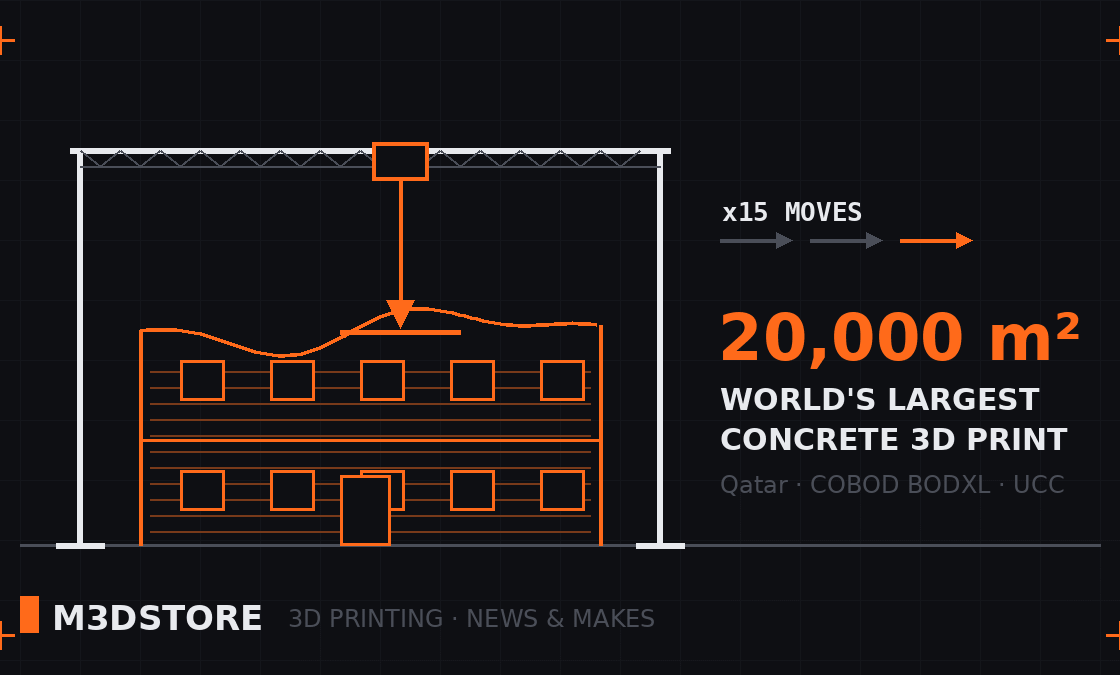
- COBOD’s BODXL — at 50 × 30 × 15 m the largest construction 3D printer ever built — still wasn’t big enough. It has been dismantled and reassembled 15 times to cover the 100 × 100 m plot, with the final move now in progress.
- Each printed school spans 20,000 m² over two storeys, which UCC says is about 40 times larger than any 3D-printed building completed before this project.
- The schools are part of a 14-school program with Qatar’s Public Works Authority (Ashghal); completion has slipped past the original end-of-2025 target, but the milestone resets the scale ceiling for 3D concrete printing.
The biggest concrete 3D print in history is nearly done. In a LinkedIn update spotted this week by Fabbaloo, Muamer Demir, Head of 3D Printing Construction at Qatar’s UCC Holding, reported that the flagship structure of the country’s 3D Printed Schools Project is approaching completion — a building he describes as “the largest 3D printed building unit ever constructed” and the product of “the largest 3D concrete printing operation ever executed.”
Two schools, 40,000 square meters, one enormous printer
The project has been on the industry’s radar since UCC Holding and Denmark’s COBOD announced it in 2024. Qatar’s Public Works Authority (Ashghal) commissioned 14 new public schools, and two of them were earmarked for 3D printing. Each printed school has a built-up area of 20,000 m² across two storeys, sitting on a 100 × 100 m plot — a combined 40,000 m² that UCC Holding says is roughly 40 times larger than the largest 3D-printed building that existed when the project began.
To print them, COBOD supplied two customized BODXL gantry printers, each 50 m long, 30 m wide and 15 m tall — about the footprint of an aircraft hangar, and the largest construction 3D printers in the world. The machines extrude a cement-based mixture layer by layer, building up the structural walls before conventional crews add roofs, windows, fit-out and finishes. The architecture leans into the process: the walls curve and flow like the desert dunes that inspired the design, geometry that would be expensive to form conventionally, as New Atlas reported when construction ramped up.
The printer moved 15 times to finish one building
The most striking detail in Demir’s update is logistical. Even a printer the size of a hangar can’t span a 100 × 100 m plot, so the team has been printing a section, tearing the entire BODXL down, reassembling it on a fresh position and printing again — 15 times in total, with the fifteenth and final relocation now underway. So far the operation has produced about 19,500 m² of printed built area (close to the 20,000 m² specification) and extruded more than 28,000 m² of concrete walls.
That workaround is a preview of the next engineering problem in 3D construction printing. Gantry printers deliver precision and scale, but repeatedly dismantling and recommissioning a 750 m² machine costs time and money. Fabbaloo’s Kerry Stevenson raises the obvious question: does all that teardown erode the economics compared with conventional building? If structures at this scale become routine, expect printer makers to answer with systems that relocate themselves — crawling gantries, rail-mounted rigs or swarms of smaller robots.
Why this matters
3D concrete printing has spent a decade proving itself on houses, villas and the occasional apartment block. A 20,000 m² public school is a different category of building: institutional, code-governed and built for decades of heavy use. Delivering it — even behind the original end-of-2025 schedule — demonstrates that 3DCP can operate at civic-infrastructure scale, not just demo-home scale.
It also puts a large asterisk on every “world’s largest 3D-printed building” record to date. Previous title holders measured in the low hundreds of square meters; Qatar’s schools multiply that by two orders of magnitude. As Stevenson notes, this is a record that probably won’t stand long — once one 20,000 m² print is proven, someone will attempt a bigger one. The record now is less about the number and more about the proof: the scale ceiling that constrained construction printing has moved, dramatically.
FAQ
How big are Qatar’s 3D-printed schools?
Each of the two printed schools has a built-up area of 20,000 m² (about 215,000 sq ft) over two storeys, on a 100 × 100 m plot — a combined 40,000 m². UCC Holding says that is roughly 40 times larger than any 3D-printed building completed before this project.
What printer is being used?
Two customized COBOD BODXL gantry printers, each 50 m long, 30 m wide and 15 m tall — the largest construction 3D printers ever built. Even so, each school required the printer to be dismantled and reassembled 15 times across the plot.
Who is behind the project?
UCC Holding is the main construction partner, working with Qatar’s Public Works Authority (Ashghal) on a program of 14 public schools, two of which are 3D printed using COBOD equipment.
Are 3D-printed buildings like this cheaper than conventional ones?
Unproven at this scale. The repeated teardown and reassembly of the BODXL adds cost that smaller prints don’t face, and neither UCC nor COBOD has published final cost comparisons. The clearer benefits so far are geometric freedom and reduced formwork, not a demonstrated price advantage.
Related reading: Ursa Major Wraps $25M Navy Pathfinder, Proving 3D-Printed Solid Rocket Motors Can Scale · Metal 3D Printing Goes to Sea: US Navy Tests Hybrid Print-and-Mill Container Aboard USS Essex at RIMPAC 2026
Sources: Fabbaloo, Muamer Demir / LinkedIn, UCC Holding, New Atlas, COBOD

M3Dstore
Writer at M3D — exploring how 3D printing changes the way we learn, make and live.
Leave a Reply