Key takeaways
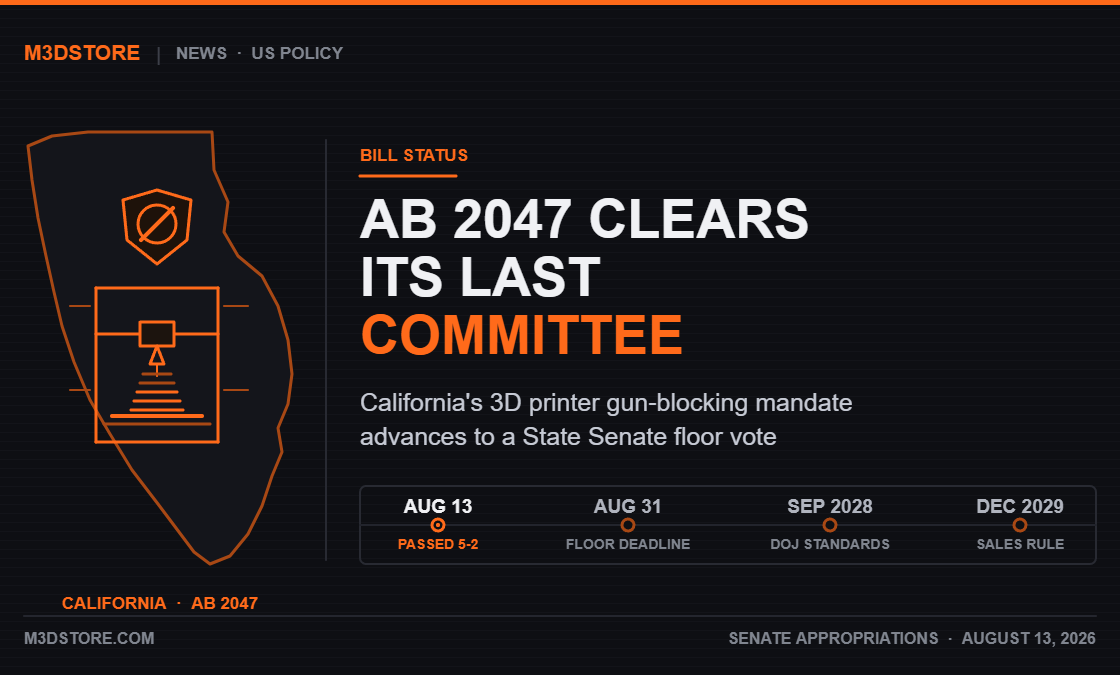
- On August 13, 2026, the California Senate Appropriations Committee pulled AB 2047 off its suspense file on a 5–2 “do pass as amended” vote — the last committee standing between the bill and a Senate floor vote.
- AB 2047 would require 3D printers sold in California to ship with state-sanctioned “firearm blocking technology”: DOJ performance standards by September 1, 2028, manufacturer attestations by March 1, 2029, and a ban on selling or transferring non-listed printers from December 1, 2029.
- The Legislature has until August 31, 2026 — the constitutional end of the two-year session — to pass it. No floor vote, no bill.
- Amendments have narrowed it along the way: private resale is carved out, the entertainment industry is carved out, and the performance standard was softened from defeating “a technically skilled user” to merely “substantially reduc[ing] the likelihood of foreseeable circumvention attempts.”
- The EFF and much of the maker community oppose it as unworkable surveillance; New York enacted the first mandate of this kind earlier in 2026.
The most consequential piece of 3D printing legislation in the United States just cleared its final procedural obstacle. On August 13, California’s Senate Appropriations Committee voted 5–2 to move AB 2047, the California Firearm Printing Prevention Act, off the suspense file with a “do pass as amended” recommendation. The bill now sits on the Senate floor calendar with roughly two weeks left in the session.
What actually happened on August 13
The suspense file is where California parks bills with meaningful fiscal impact until the Appropriations Committee decides, usually in a rapid-fire hearing, which ones survive. AB 2047 went onto the Senate’s suspense file on August 3 by a unanimous 7–0 vote — a procedural parking, not an endorsement. Ten days later it came back off. According to the roll call, Senators Cabaldon, Cervantes, Wahab, Richardson and Grayson voted aye; Senators Seyarto and Dahle voted no.
The timing was not incidental. Under the 2026 legislative calendar, August 14 was the last day for fiscal committees to meet and report bills. Had AB 2047 stayed on suspense through that date, it would have died there quietly, which is what happens to a large share of suspense-file bills every year.
The bill has been moving since February. Introduced on February 17 by Assemblymember Rebecca Bauer-Kahan (D–16) with coauthors Grayson, Patel, Rogers and Stefani, it passed the Assembly floor 58–19 on May 26, then cleared Senate Judiciary 11–2 on June 23 and Senate Public Safety 5–1 on June 30. Every one of those votes has split roughly along party lines.
What AB 2047 would require
The bill’s central mechanism is a “firearm blueprint detection algorithm” — software or firmware that inspects each print file and refuses jobs it flags as a firearm or firearm component. The rollout is staged over three years. The California Department of Justice would publish performance standards for those algorithms by September 1, 2028. Manufacturers would then file attestations with the DOJ by March 1, 2029, and the department would maintain a public list of compliant machines. From December 1, 2029, selling or transferring a 3D printer in California that lacks blocking technology and is not on that list becomes unlawful, with carve-outs for specified industries and law enforcement.
Two enforcement hooks sit alongside the sales rule: knowingly disabling the blocking technology with intent to manufacture a firearm becomes a crime, and the bill creates a civil cause of action against those who sell non-compliant printers. Notably, there is no requirement to retrofit machines already in service — the obligation attaches at the point of sale.
The amendments that reshaped it
The version heading to the floor is not the one introduced in February. The Electronic Frontier Foundation, which has tracked the bill since April, notes that the original text would have criminalised private resale of printers bought before the mandate; that provision is gone. An open-source carve-out was added, but it only applies where the open-source tool itself includes compliant blocking software — which the EFF argues leaves independent developers exposed to standards they cannot realistically meet. A further exemption was added for the entertainment industry, which uses 3D printers heavily for props and costumes.
The most telling change is to the performance bar itself. Earlier text required algorithms to “effectively prevent a technically skilled user from evading” them. The current standard asks only that they “substantially reduce the likelihood of foreseeable circumvention attempts.” That is a meaningful retreat, and both supporters and critics can read it their own way: as pragmatic drafting, or as an admission that the technology being mandated does not exist.
The argument on both sides
Supporters frame AB 2047 as closing a gap that existing law cannot reach. Unlicensed home manufacture of firearms is already illegal, but untraceable printed frames and receivers carry no serial numbers and can be produced by people barred from buying guns. The bill’s novelty — and, to its authors, its appeal — is that it regulates the equipment rather than the individual, the same logic behind the campaign in which twenty US prosecutors asked Bambu Lab, Creality and Flashforge to build blocking technology in voluntarily. New York moved first, enacting a comparable mandate earlier this year.
Opponents make a mostly technical case. A firearm receiver is, geometrically, an unremarkable bracket; there is no reliable way to distinguish it from thousands of legitimate mechanical parts, and files can be rescaled, split into sub-assemblies or sliced on unmodified software. Any filter tuned tightly enough to catch gun parts will block lawful prints, and any filter loose enough to avoid that will miss the determined. The EFF adds a privacy argument: a system that inspects every print file creates a standing record of what engineers, students and businesses are making, with the attendant risk of design leakage. Desktop machines also cannot print a complete working firearm — barrels and springs remain metal — which critics say makes the printer the wrong place to intervene.
What happens next
AB 2047 needs a majority on the Senate floor before August 31. Because the Senate amended it, passage there would send it back to the Assembly for a concurrence vote on those amendments before it could reach the Governor’s desk. If the Senate does not take it up in time, the bill dies with the 2025–2026 session and would have to start over.
For anyone with a printer on a desk today, nothing changes this month. Even on the fastest path, the first binding obligation — DOJ performance standards — is more than two years out, and the sales restriction is three. What is changing now is the direction of travel: two years ago this was a fringe legislative idea, and it is currently one floor vote away in the largest state economy in the country.
FAQ
Does AB 2047 ban 3D printers in California?
No. It would restrict which printers may be sold or transferred in the state from December 1, 2029 — only machines equipped with approved blocking technology and listed by the California DOJ. Owning and using a printer is not prohibited.
Would I have to modify a printer I already own?
The bill imposes no retrofit requirement on existing machines, and amendments removed the original ban on private resale of printers bought before the mandate. The obligations fall on manufacturers and sellers of new printers.
When would any of this actually take effect?
In stages: DOJ performance standards by September 1, 2028; manufacturer attestations by March 1, 2029; and the sales and transfer restriction from December 1, 2029.
What happens if the Senate does not vote by August 31?
August 31 is the constitutional deadline for each house to pass bills in the 2025–2026 session. A bill that has not passed by then dies and would need to be reintroduced in a future session.
Related reading: 20 US Prosecutors Ask Bambu Lab, Creality and Flashforge to Build Gun-Blocking Tech Into Every Printer · Bambu Lab Cleans Up MakerWorld: Over 1,000 Models Hit in NSFW Crackdown
Sources: California Legislative Information (AB 2047), FastDemocracy vote records, BillTrack50, Electronic Frontier Foundation, California State Senate legislative deadlines.

M3Dstore
Writer at M3D — exploring how 3D printing changes the way we learn, make and live.
Leave a Reply