Key takeaways
- MIT researchers have built ShiftLens, a design-and-fabrication system that gives 3D printed objects switchable surface graphics with no sensors, circuits or batteries anywhere inside.
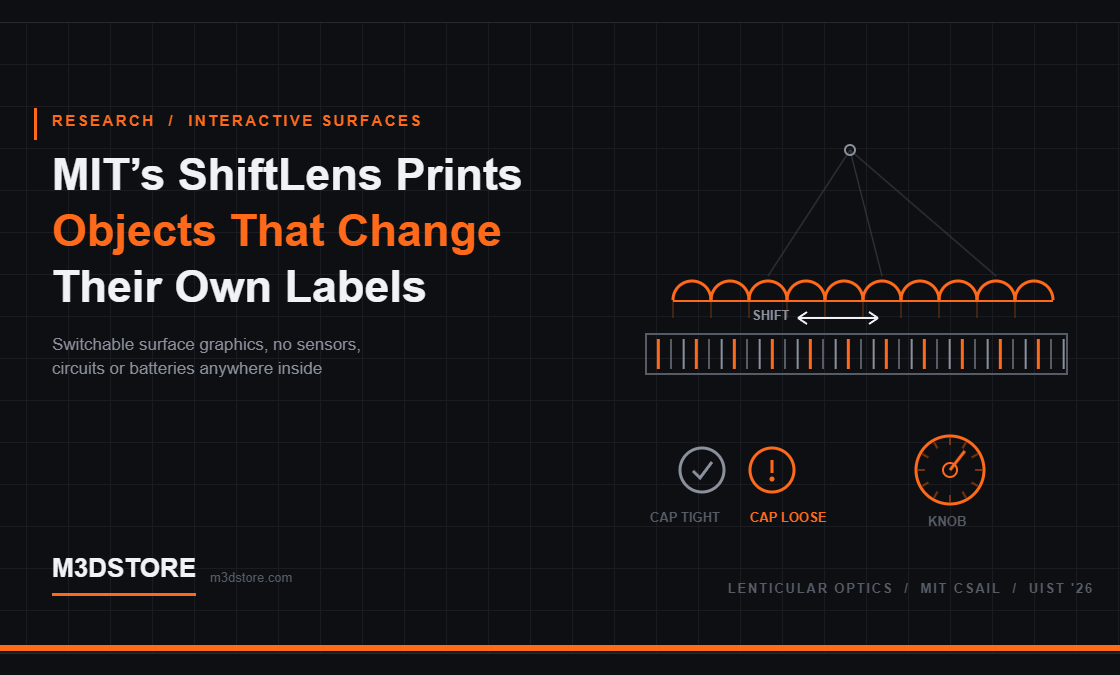
- It stacks a lenticular lens layer over a patterned backplane. Nudging one layer relative to the other brings a different set of interleaved image strips into view, and the lenses magnify them.
- The optics, the pattern layer and the mechanism that moves them all print in a single pass on a multimaterial machine — a Stratasys J55 in the paper.
- Six demos were fabricated, including a chemical bottle that shows a checkmark when the cap is tight and a hazard symbol when it is loose, plus a door sign, a click pen, a tic-tac-toe board, a lipstick tube and a candle lampshade.
- Reported limits: up to 10 discrete visual states, a 200 µm minimum printable feature, and no visible damage after 200 actuation cycles.
Imagine a bottle of something nasty on a lab shelf that turns red and throws up an exclamation mark the moment its cap is not quite tight — and does it with no battery, no sensor and no screen. That is the framing demo for ShiftLens, a design and fabrication system out of MIT’s Computer Science and Artificial Intelligence Laboratory that MIT News detailed on 5 August and that the trade press picked up this week.
The work is led by Yunyi Zhu, a graduate student in MIT’s Department of Electrical Engineering and Computer Science, with co-authors at MIT, the Technical University of Munich and Northeastern University, and senior author Stefanie Mueller. The paper is going to UIST ’26, the ACM’s user interface software conference.
Two optical layers, one print
The physics is not new — the execution is. ShiftLens puts an array of tiny lenticular lenses, the same curved strips that make novelty postcards flip, on top of a patterned backplane. That backplane carries interleaved strips of every image the surface is supposed to show. Slide the lens layer a fraction of a lens pitch and a different set of strips falls under the lenses, which magnify them. The surface changes.
The important word is slide. Ordinary lenticular printing is viewpoint-dependent: what you see depends on where you are standing. Here the state is set by physical displacement, so the object holds a definite state — one that can be coupled to something it already does, like a cap screwing down or a pen tip clicking out.
Getting three domains to agree was the hard part. “The biggest challenge in this project was to make sure all moving parts align. We need to make sure that the optical effect, mechanical linkages, and computational graphics align with one another,” Zhu told MIT News. The whole assembly then comes off the printer finished — the team’s samples were printed in one pass on a Stratasys J55 using VeroClear and VeroVivid CMYW resins with water-soluble support, with no assembly step.
Switch, roller, knob
When an object has no useful motion of its own, ShiftLens supplies one of three printed actuators, and the choice caps how many images you get. A switch is a rocker that snaps between two fixed end positions: exactly two states. A knob drives a rack and pinion with optional detents and supports up to five. A roller sweeps smoothly and supports up to ten.
The rest is hidden behind a design tool built in Rhino and Grasshopper. Give it a surface, an actuation type and one image per state; it generates the lens array, the interlaced pattern layer and the mechanism geometry, simulates the result and exports a print-ready file.
The geometry you can’t cheat
ShiftLens will not go on any shape you like, and the paper is refreshingly blunt about why. The two layers have to keep a constant spacing while they move past each other, which restricts the surface to three families: translation surfaces (extruded forms), surfaces of revolution (cylinders, cones, bowls) and combined screw-like surfaces. Anything generated by, say, a sine-wave path or non-uniform scaling will either bind or fall out of alignment.
There is an optical trade-off too: curvier lenses show more of the intended strip but narrow the cone you can view it from. And because each state occupies a strip of width pitch÷N, resolution sets a hard cap — the team could not reliably print features below 200 µm, so a 3 mm pitch buys fewer states than a 5 mm one. On curved surfaces it compounds, since lenses away from the centre face you obliquely and dim first.
Durability looks better than you might expect from printed gears: coupons of each mechanism were actuated 200 times with no visible damage, provided rails and backplane stayed at the tested thicknesses.
Why it matters
Every “smart object” story for the last decade has meant putting a microcontroller inside something. That is the wrong answer for a lot of objects: anything soaked, sprayed with solvent, dropped, autoclaved or left outdoors, and anything that must stay legible when the battery is flat. ShiftLens argues that a useful slice of interactivity is a printable material property, not a component you bolt on.
It is also a coherent next step for this lab rather than a one-off. Its 2022 Lenticular Objects work put lenticular optics on curved printed surfaces but left the visible state up to the viewer’s position; FabObscura got repeatable, motion-driven switching but mostly on flat parts. ShiftLens is where the two meet.
The obvious caveat is the machine. This is polyjet work — multimaterial, transparent-resin, sub-200 µm territory — and none of it drops onto the printer on your desk today. Whether the technique survives contact with cheaper hardware, or gets picked up by a packaging firm that already owns the right machines, is the open question.
FAQ
Can I print a ShiftLens object on a desktop FDM machine?
No. The process needs a multimaterial polyjet printer laying down clear lens material and coloured pattern material in the same pass at sub-200 µm resolution — the team used a Stratasys J55. FDM cannot produce optical-grade lenticules or the interlaced colour strips beneath them.
How many different images can one surface show?
Up to ten under the fabrication limits in the paper, and the actuator caps it further: two for a switch, five for a knob, ten for a roller. More states mean narrower strips and a tighter viewing angle, so two or three is the sensible choice for a safety indicator.
Is the design tool available to download?
Not as a public release at the time of writing. The paper, figures and demo video are on the CSAIL project page; the tool itself is a Rhino/Grasshopper research prototype presented at UIST ’26.
Does the mechanism wear out?
Not in testing. Each actuator was cycled 200 times on a 50 mm square coupon with no visible damage. The team recommends keeping rail and backplane thicknesses at or above the tested values and using hard end stops or detents so the layers cannot over-travel.
Related reading
More printed things that work without a power supply: TU Graz’s 3D-printed ceramic cubes cooled a room by nearly 7 °C with no electricity. And if the printer question above is the one you care about, start with our FDM vs resin 3D printers guide for 2026.
Sources: MIT News, the ShiftLens project page and UIST ’26 paper (MIT CSAIL HCI Engineering group), and 3D Printing Industry.

M3Dstore
Writer at M3D — exploring how 3D printing changes the way we learn, make and live.
Leave a Reply