Key takeaways
- Artec 3D has launched the Point II, the second generation of its handheld, target-based laser scanner for industrial metrology, replacing the original Artec Point in the lineup.
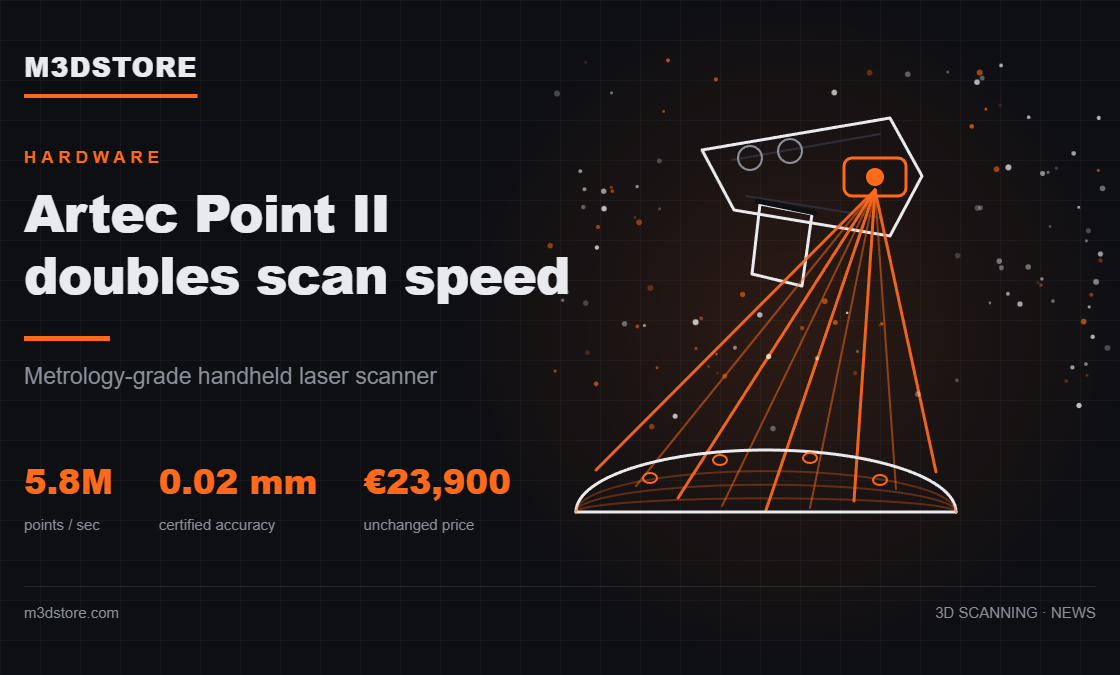
- Capture rate more than doubles to 5.8 million points per second, using an expanded laser setup of 54 lines in ultra-fast mode and 17 parallel lines in hyperfine mode.
- Accuracy is unchanged at 0.02 mm, verified in an ISO-certified lab and compliant with the VDI/VDE 2634 and JJF 1951 metrology standards.
- The price also holds at €23,900 — the same as the outgoing Point — and the scanner is available now through Artec’s certified partner network.
- Three scan modes cover large surfaces, fine detail, and deep holes; the scanner is tethered, with no wireless mode.
Artec 3D has released the Artec Point II, a second-generation handheld laser scanner aimed squarely at industrial metrology. It replaces the original Point, and the headline number is throughput: up to 5.8 million points per second, more than twice what the first-generation scanner managed. Everything else that professionals actually build workflows around — the accuracy rating, the software, the price — stays exactly where it was.
More data per pass, not a new machine
The speed gain comes from a wider laser configuration rather than a redesigned scanner. Point II projects 54 laser lines in ultra-fast scanning mode and 17 parallel lines in hyperfine mode, so each pass over a part pulls in far more surface data than before. Operators can switch between three modes: ultra-fast for covering large surfaces quickly, hyperfine parallel scanning for intricate detail, and a single-laser mode for deep holes and other geometry a multi-line grid cannot reach.
“Artec Point set a high bar for accessible, certified metrology. Point II raises it — more data in every pass, greater detail, and faster scans, with the same accuracy professionals have come to rely on.”
Art Yukhin, president and CEO, Artec 3D
Physically, it is a palm-held unit built for one-handed operation and tilting into confined spaces, with an IP50 dust-protection rating and a −10 °C to 40 °C operating range. Artec is pitching it at manufacturing, mold-making, energy, and heavy industry — environments where the scanner leaves the metrology room. One practical caveat worth knowing before you spec it: as DEVELOP3D notes, the Point II is tethered. There is no wireless mode.
Accuracy stayed still — and that is deliberate
It would have been easy to chase a smaller accuracy figure for the spec sheet. Artec did not. Point II is certified at 0.02 mm accuracy and 0.02 mm resolution, the same as the scanner it replaces, with results validated in an ISO-certified lab and compliance claimed against VDI/VDE 2634 and JJF 1951.
That restraint makes sense once you think about how metrology hardware is actually bought. A certified accuracy number is a number that inspection procedures, supplier agreements, and audit trails are written around. Change it and every downstream document has to be revisited. Double the capture rate instead and the same procedure simply finishes sooner. For a quality department, faster is a scheduling win; different is a paperwork problem.
Why scanning speed matters to anyone who prints
It is tempting to file a €23,900 metrology scanner under “not my problem” if your world is desktop FDM. But the reverse-engineering and inspection loop is exactly where additive manufacturing keeps hitting friction, and scan time is a real part of that loop. Every replacement part digitised from a legacy assembly, every printed fixture checked against nominal CAD, every first-article inspection on a production run — each one is bounded by how long it takes to turn a physical object into trustworthy points.
Point II feeds into Artec Studio, where its data can be combined with captures from other Artec scanners inside a single project. That matters more than it sounds: mixed-device projects are how shops handle parts that need one scanner for broad geometry and another for fine features, without stitching data across incompatible toolchains.
The pressure to close that loop is coming from the print side too. We recently covered NASA’s work on “born qualified” metal 3D printing, where the goal is to certify a part from process data rather than inspect it afterward. Until that arrives at scale, measurement remains the gate — and the gate is only as fast as the scanner in front of it.
Artec’s familiar upgrade playbook
Point II follows a pattern the company has run before: upgrade the hardware inside a proven scanner instead of launching a new model line. The Micro II did it in 2023, doubling the original Micro’s accuracy to 5 microns while keeping the one-click workflow intact. The 2022 edition of Artec Leo did it too, doubling processing power through a new chipset while leaving the touchscreen, wireless design, and form factor alone.
It is a conservative strategy, and in metrology that is a feature. Customers who already have Point in their inspection procedures get more throughput without re-validating anything. Whether it is enough to hold ground in an increasingly crowded handheld scanning market — FARO’s CREAFORM line and Hexagon both expanded their portfolios in recent weeks — is the more interesting question.
FAQ
How fast is the Artec Point II?
Up to 5.8 million points per second — more than double the original Artec Point. The gain comes from projecting 54 laser lines in ultra-fast mode and 17 parallel lines in hyperfine mode.
How accurate is the Artec Point II?
0.02 mm accuracy and 0.02 mm resolution, unchanged from the first-generation Point. Artec says the figures are verified in an ISO-certified lab and comply with VDI/VDE 2634 and JJF 1951.
How much does the Artec Point II cost?
€23,900, the same price as the model it replaces. It is available now through Artec 3D’s global network of certified partners.
Is the Artec Point II wireless?
No. The Point II is a tethered scanner with no wireless mode, unlike Artec’s Leo. It is IP50-rated for dust and specified for operation between −10 °C and 40 °C.
What software does it use?
Artec Studio, the company’s scanning and processing suite. Point II data can be combined with captures from other Artec scanners in the same project, covering reverse engineering through to quality inspection.
Related reading: NASA Is Testing ‘Born Qualified’ Metal 3D Printing — 50,000 Layers at a Time · HeyGears G1 Series Goes Live on Kickstarter: Desktop Full-Color 3D + UV Printing
Sources: Artec 3D, 3D Printing Industry, DEVELOP3D.

M3Dstore
Writer at M3D — exploring how 3D printing changes the way we learn, make and live.
Leave a Reply