Key takeaways
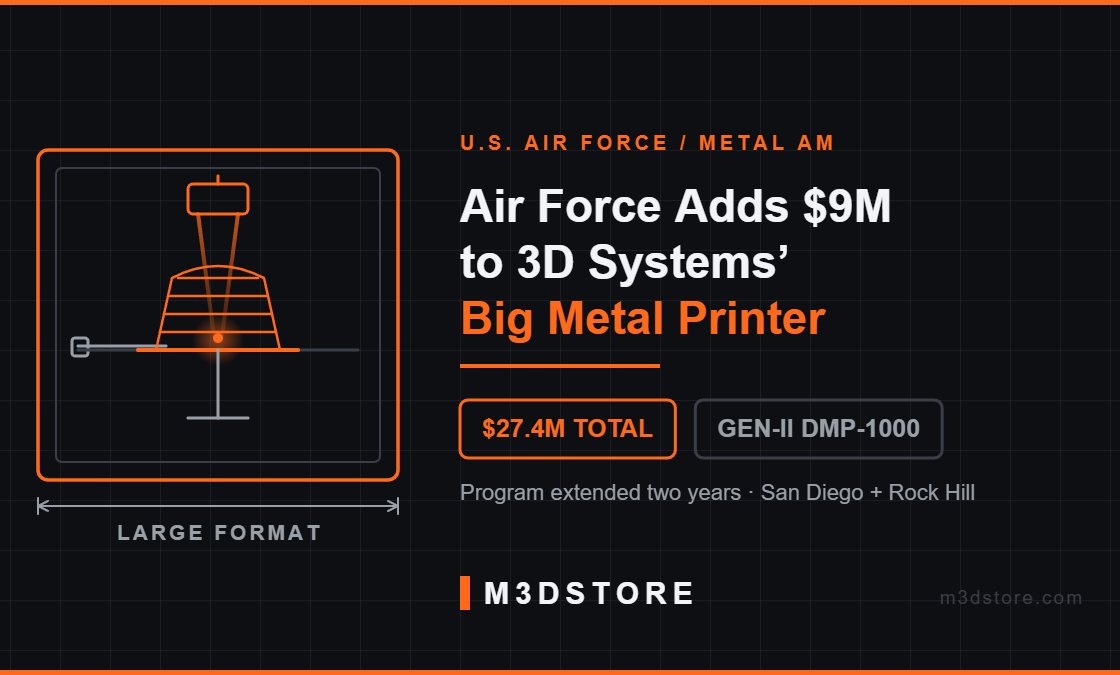
- 3D Systems (NYSE: DDD) has been awarded an additional $9 million under the US Air Force-funded Large-Format Metal 3D Printer Advanced Technology Demonstrator programme, internally designated GEN-II DMP-1000. The company announced it on 10 August 2026.
- The award extends the programme by two years and lifts total project funding to $27.4 million. 3D Systems has been executing the work since 2023.
- The goal is large-scale, high-temperature, flight-relevant metal printing — parts that can go on an aircraft, not just in a test rig. Work stays at 3D Systems’ San Diego, California and Rock Hill, South Carolina facilities.
- Almost nothing about the machine itself is public: no build volume, no throughput numbers, no launch date. The “DMP-1000” name is the strongest hint anyone has.
- Stratasys collected $7.8 million the same week from the 2026 America Makes / Department of War Organic Industrial Base Modernization Challenge — a separate pot, same underlying trend.
What 3D Systems actually won
On 10 August, 3D Systems announced an additional $9 million award under the Air Force’s Large-Format Metal 3D Printer Advanced Technology Demonstrator programme. It is not a new contract so much as the next scheduled phase of one that has been running since 2023 — and, according to the company, the phase that completes the technology demonstration.
The headline number in the release is not the $9 million. It is the cumulative one. “This award increases total project funding to $27.4 million and reflects the U.S. Air Force’s continued confidence in our technology, its development path, and our teams,” said Dr Michael Shepard, Vice President, Aerospace & Defense at 3D Systems. He added that the team looks forward to “working with additional partners on new applications as the platform matures.”
For scale: the previous tranche, awarded around this time last year, was $7.65 million. The Air Force is not tapering off. It is stepping up and buying two more years.
A machine nobody outside the programme has seen
Here is the strange part. Three years and $27.4 million into a printer development programme, the public technical record is close to empty: no build volume, no laser count, no build rate, no images, no delivery date beyond the two-year extension.
TCT Magazine makes the most reasonable inference available: 3D Systems’ existing DMP Factory 500 has a roughly 500 mm-cubed build envelope, so a system carrying the “DMP-1000” designation most likely measures around 1,000 mm in at least one axis. That is inference from a product name, not a spec sheet — worth treating as such.
What the press release does commit to is the application envelope: large-scale, high-temperature and flight-relevant. In laser powder bed fusion, those three words together are the hard part. Scaling a build chamber is mostly an engineering problem. Keeping melt-pool behaviour, thermal gradients and residual stress consistent enough across a metre-class plate that the resulting part can be signed off for flight is the problem that has kept large-format metal PBF out of production for a decade.
Stratasys took $7.8M from the same week’s defence pot
The 3D Systems award did not land alone. America Makes and the NCDMM announced the winners of the 2026 Department of War Organic Industrial Base Modernization Challenge on the same day — up to $15 million in total, funded through the Office of the Under Secretary of War, Manufacturing Technology Office.
Six winners were named: Honeywell, HRL Laboratories, Machina Labs, Accenture Federal Services, REM Surface Engineering and Stratasys. Stratasys’ slice is $7.8 million over 24 months to build in-situ monitoring into its F3300 and F900 industrial FDM platforms — process data generated during the build, so that fewer parts need to be inspected after it.
Read the two awards together and a pattern shows up. One funds a bigger machine. The other funds the ability to trust what comes off machines you already own. Both are bottlenecks; neither gets solved by a printer launch.
Why it matters
Context matters for 3D Systems specifically. The company reported $94.6 million in Q2 2026 revenue on 3 August and announced a CEO transition plan the following day, with Dr Jeffrey Graves stepping down and a search underway for a successor. A commercial 3D printer business under that kind of pressure does not fund a speculative metre-class metal platform out of operating cash. Government money does.
That is the wider story in additive right now. The consumer end of the market is driven by volume and price competition; the industrial end is increasingly underwritten by defence budgets — sustainment, readiness, point-of-need production, and the qualification infrastructure that makes any of it usable.
These programmes do tend to produce technology that eventually reaches commercial buyers. The risk is concentration: an industry whose next machine generation leans this heavily on one customer’s procurement cycle is exposed to that customer’s budget politics. Worth watching when the demonstration wraps.
FAQ
What is the GEN-II DMP-1000 programme?
It is the US Air Force-funded Large-Format Metal 3D Printer Advanced Technology Demonstrator, run by 3D Systems since 2023. The aim is to develop and demonstrate large-scale metal 3D printing for high-temperature, flight-relevant components.
How much has been spent on it so far?
$27.4 million in total project funding, including the new $9 million award announced on 10 August 2026 and a $7.65 million tranche awarded the previous year.
How big is the printer?
3D Systems has not published a build volume. The “DMP-1000” designation suggests roughly 1,000 mm in at least one axis, given that the existing DMP Factory 500 is a 500 mm-class machine — but that is an inference, not a confirmed specification.
Can I buy one?
Not yet. This is a technology demonstration programme, not a product launch. 3D Systems has said it expects to work with additional partners on new applications “as the platform matures,” which implies commercial availability is a later step and no date has been given.
Related reading
More on where metal AM qualification and defence production are heading: NASA Is Testing ‘Born Qualified’ Metal 3D Printing — 50,000 Layers at a Time and Haddy Printed a Military Drone Boat With Robot Arms — but Won’t Say Who It’s For.
Sources: 3D Systems press release, TCT Magazine, VoxelMatters, America Makes / NCDMM.

M3Dstore
Writer at M3D — exploring how 3D printing changes the way we learn, make and live.
Leave a Reply