Key takeaways
- Velo3D posted $20.7 million in Q2 2026 revenue — up 52.3% from $13.6 million a year ago, and well ahead of the roughly $13.5 million analysts expected.
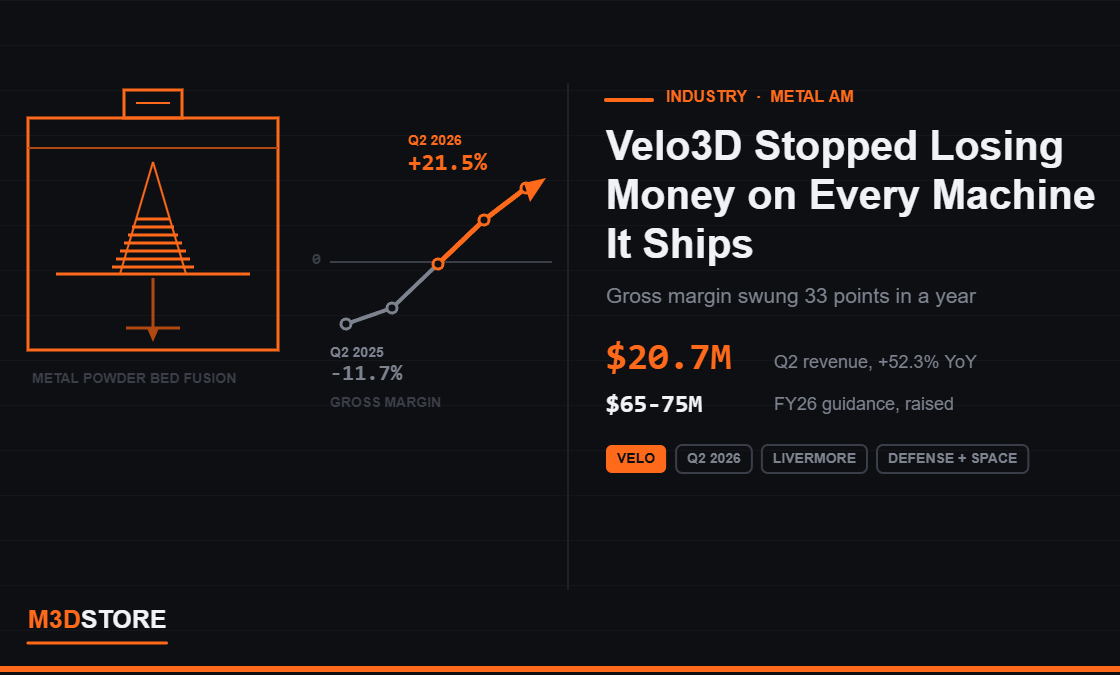
- Gross margin swung from −11.7% to +21.5%, a 33-point move. Gross profit was $4.4 million against a $1.6 million gross loss in Q2 2025 — the company is no longer losing money on the hardware itself.
- Full-year guidance went up to $65–75 million from $60–70 million, with management targeting gross margin above 30% and positive EBITDA in the second half.
- $29 million in new bookings, $31 million backlog, $91.1 million in cash, and total debt cut by more than 70% to $8.2 million — funded by roughly $110 million of equity raised during the quarter.
- One asterisk: part of the margin gain came from moving certain labour and overhead costs out of cost of revenue and into operating expenses. Operating costs rose from $10.0 million to $15.5 million in the same period.
Metal 3D printing has spent three years being the part of the industry that everyone agreed was strategically important and nobody could make pay. Velo3D’s second quarter, reported after the close on 11 August, is the first clean counter-example in a while: revenue up 52.3% to $20.7 million, and a gross margin that finally sits on the right side of zero.
The market noticed. Shares rose about 17.6% in after-hours trading on the day of the release, according to Benzinga. Revenue came in at roughly 53% above consensus — the kind of gap that usually means the analysts modelling the company had stopped believing the pipeline.
The number that matters is 21.5%
Revenue growth is the headline, but the margin is the story. In Q2 2025 Velo3D booked $13.6 million of revenue against $15.2 million in cost of revenue — a gross loss of $1.6 million, or −11.7%. Every Sapphire system that left the building took money with it.
This quarter, $20.7 million of revenue against $16.2 million of cost produced $4.4 million of gross profit, or 21.5%. Cost of revenue rose by $1.0 million while revenue rose by $7.1 million. That is what operating leverage looks like when a machine builder finally gets volume through a fixed cost base.
The company is guiding to more than 30% gross margin in the second half and positive EBITDA over the same period. Net loss narrowed to $11.5 million from $13.3 million, and adjusted EBITDA loss to $8.1 million from $8.9 million — improvement, but not yet a profitable business.
Where the growth came from
Printer and parts revenue — the bulk of the total — hit $19.0 million, up 57% from $12.1 million. Velo3D attributes that to higher average selling prices, a better product mix, and growing volume through Rapid Production Services (RPS), its parts-on-demand arm. Support, service, licence and recurring revenue was $1.7 million, up modestly from $1.5 million.
Two details in the earnings deck matter more than the revenue split. First, repeat customers have consistently accounted for more than 80% of orders. Second, defence and aerospace were the primary drivers of pipeline growth in the quarter. Velo3D is not winning by finding new logos; it is winning by selling second, third and fifth machines into programmes that already qualified its process. Mears Machine ordered its fifth Sapphire XC during the quarter, with options for two more.
It also signed a partnership with Aurelia Technologies aimed at next-generation gas turbine components — design consolidation, faster iteration, shorter supply chains. Energy is the obvious third leg once defence and space are established.
The asterisk on the margin
Velo3D says the margin improvement reflects a refinement in how certain labour and overhead costs are allocated between cost of revenue and operating expenses, alongside higher selling prices, mix, RPS revenue and manufacturing efficiencies. The reallocation is legitimate accounting, but it is not free: total operating expenses jumped to $15.5 million from $10.0 million, and non-GAAP adjusted operating expenses to $13.1 million from $8.8 million.
In other words, some of the 33-point swing is cost moving from one line to another rather than cost disappearing. The bottom-line improvement — a $1.8 million narrower net loss on $7.1 million more revenue — is the honest measure of how much of this is real. It is real, but it is smaller than the gross margin chart suggests.
A balance sheet rebuilt with equity
Cash and equivalents stood at $91.1 million at 30 June, up from $39.0 million at the end of 2025. That did not come from operations, which consumed $39.5 million in the first half. It came from about $99.5 million of net financing: a $50 million registered direct offering of 3,571,428 shares in April, plus $59.4 million raised through an at-the-market programme established in May.
Combined with debt-to-equity conversions, that cut total outstanding debt by more than 70%, to $8.2 million. Velo3D also joined the Russell 3000 and Russell Microcap indices on 29 June. The company traded solvency risk for dilution — a reasonable trade for a business that was, eighteen months ago, staring at an NYSE noncompliance notice.
Livermore is where the guidance lives
The new Livermore Production Campus launched during the quarter and is expected to triple manufacturing capacity once operational later this year, becoming Velo3D’s primary production site. Full-year capital expenditure is guided at $40–50 million, largely for RPS expansion — and the company explicitly notes that figure is subject to sufficient financing being available.
That is the tension in this quarter. The $65–75 million full-year target implies a much heavier second half, which requires Livermore to come online roughly on schedule and the $31 million backlog to convert. Neither is guaranteed, and Velo3D lists both among its own risk factors.
Why it matters beyond one small-cap
Read this quarter next to the rest of August’s earnings and a pattern shows up. Stratasys held revenue flat while printer sales fell and consumables set a record, with aerospace and defence up 17%. 3D Systems posted essentially flat revenue and opened a CEO search. Xometry booked a record quarter as a marketplace, owning no machines at all.
The common thread is that defence, space and energy budgets are currently underwriting industrial additive manufacturing — and that the companies growing are the ones with a specific qualified process serving repeat programme customers, not the ones selling general-purpose capability into a broad market. Velo3D is a small company with a large story attached to it: metal AM can carry a positive gross margin, if the machine is pointed at a narrow enough problem.
FAQ
How much revenue did Velo3D make in Q2 2026?
$20.7 million, up 52.3% from $13.6 million in Q2 2025. Analysts had modelled roughly $13.5 million. First-half revenue was $34.5 million against $22.9 million a year earlier.
Is Velo3D profitable now?
No. Gross profit is positive at $4.4 million, but the company still posted a GAAP net loss of $11.5 million and an adjusted EBITDA loss of $8.1 million for the quarter. Management is guiding to positive EBITDA in the second half of 2026, not to net profitability.
Why did the gross margin improve so much?
Four reasons, per the company: higher average selling prices, a more favourable product mix, more Rapid Production Services parts revenue, and manufacturing efficiencies. A fifth reason is accounting — certain labour and overhead costs were reallocated from cost of revenue into operating expenses, which flatters the gross margin line and inflates the operating expense line at the same time.
Does this affect desktop 3D printing?
Not directly — Velo3D builds large-format laser powder bed fusion systems for aerospace, defence, space and energy customers, at prices no hobbyist encounters. Indirectly, the qualification standards being written now for defence metal parts tend to shape what the rest of the industry considers an acceptable process a few years later.
Related reading
Stratasys Sold Fewer Printers and Set a Materials Record — Defense Is Doing the Work · 3DEO and Fusion3 Shut Down as the US 3D Printing Middle Collapses
Sources: Velo3D Q2 2026 earnings presentation (SEC Form 8-K, 11 August 2026) · Velo3D press release · Benzinga · VoxelMatters. This article reports publicly disclosed financial results and is not investment advice.

M3Dstore
Writer at M3D — exploring how 3D printing changes the way we learn, make and live.
Leave a Reply