Key takeaways
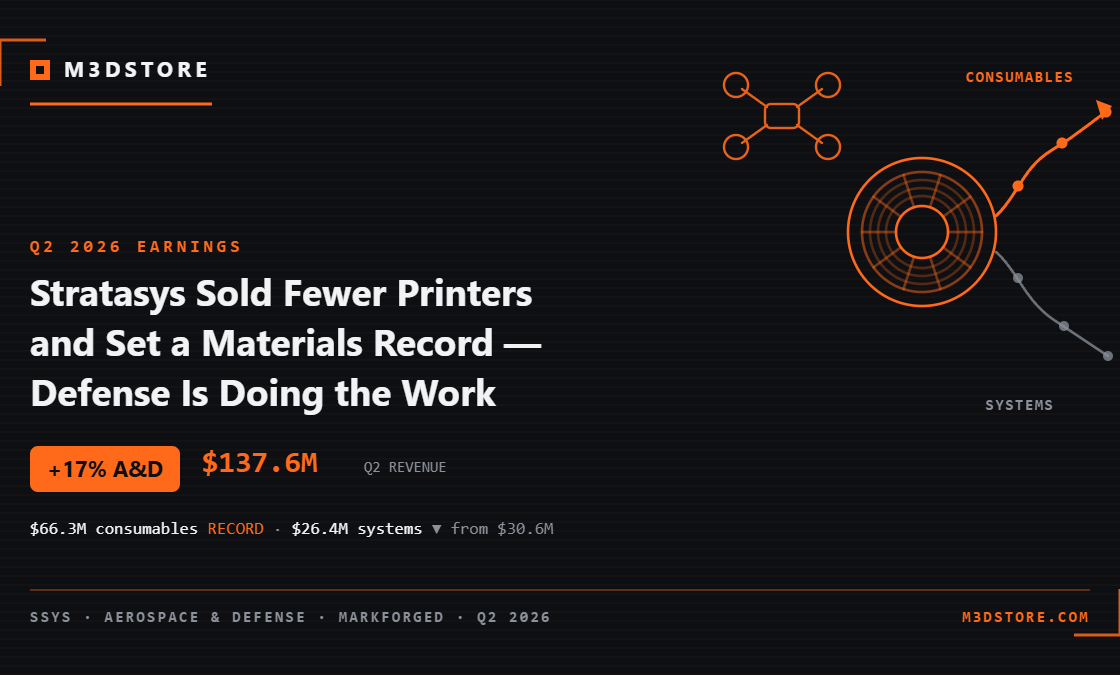
- Stratasys posted $137.6 million in Q2 2026 revenue — essentially flat against $138.1 million a year ago, but up 3.7% from Q1’s $132.7 million.
- Printer sales fell to $26.4 million from $30.6 million, while consumables hit an all-time quarterly record of $66.3 million. Materials now out-earn machines by roughly 2.5×.
- Aerospace and defense revenue grew 17% year over year and is now the company’s largest vertical, driven by U.S. Air Force sustainment work and drone manufacturers.
- Stratasys kept its full-year guidance of $565–575 million revenue and $25–30 million adjusted EBITDA — but abandoned its target of positive operating cash flow for 2026.
- The pending $42.5 million Markforged acquisition is aimed squarely at the same defense and tooling applications now carrying the business.
Stratasys (Nasdaq: SSYS) reported second-quarter results on Thursday, 13 August, and the headline number is boring on purpose: $137.6 million in revenue for the quarter ended 30 June, against $138.1 million in the same quarter last year. Flat. What is not flat is the mix underneath it — and that mix is the actual story.
Machines down, materials at a record
System revenue — the printers themselves — came in at $26.4 million, down from $30.6 million a year earlier. Consumables went the other way, reaching a quarterly record of $66.3 million versus $64.2 million. Services rose to $44.9 million from $43.3 million, and Stratasys Direct, the company’s on-demand parts arm, grew 12.1% year over year.
Read that ratio again. Stratasys now earns about two and a half dollars from filament, resin and powder for every dollar it earns selling a printer. That is not a company that sells machines with a materials attachment; that is a materials company with a hardware division. CEO Yoav Zeif framed the record as evidence that installed machines are being worked hard — consumables growth, in his telling, is a proxy for utilisation, and utilisation is a proxy for the shift from prototyping to production.
He is not wrong, but the reading cuts both ways. High consumables revenue with soft system revenue also describes a mature installed base that nobody is expanding. On the earnings call, William Blair’s Brian Drab pointed out that system sales were below both last year and the same quarter two years ago. Zeif’s answer was that big manufacturing deals close on their own schedule and quarterly comparisons have stopped being meaningful, and he told analysts to expect “a notable uptick in system sales” in the second half. That promise is now the single most watchable number in the back half of Stratasys’s year.
Defense is now the biggest vertical
Aerospace and defense revenue grew 17% year over year and is now Stratasys’s largest and highest-value vertical. The detail behind that number is more interesting than the number: management said multiple F900 systems are being deployed across the U.S. Air Force sustainment network to produce flightworthy parts — not one-off machine sales, but qualified programmes that generate repeat material orders once the part and process are locked in. That is precisely the recurring-revenue shape the consumables record reflects.
Drones are the other engine. Zeif said Stratasys Direct produced more than 12,000 aerospace and defense parts during the quarter, mostly for drones, and that the business is working with what he described as the top ten drone companies — with its highest backlog to date. Elsewhere, Quickparts committed to twelve Neo 800+ stereolithography systems on top of the six it already runs, China’s FAW Group agreed to buy twelve F900s by year-end for end-use car interior parts, and Stratasys picked up a two-year, $7.8 million America Makes programme covering monitoring for the F900 and a future F3300 refresh.
The cash flow line that changed
Losses narrowed: a GAAP operating loss of $13.5 million against $16.6 million a year ago, and a net loss of $16.9 million (–$0.19 per share) versus $16.7 million (–$0.20). On an adjusted basis the company stayed in the black at $2.3 million, or three cents a share. Adjusted EBITDA slipped to $5.3 million from $6.1 million, though Stratasys notes it would have been $8.2 million without a $2.9 million hit from the strong Israeli shekel — the same currency pressure that pushed GAAP gross margin down to 42.3% from 43.1%.
The genuine negative is cash. Stratasys burned $18.7 million in operating cash during the quarter, against $1.1 million a year earlier, which CFO Eitan Zamir attributed partly to one-off legal costs incurred to protect the company’s IP. As a result, the company reaffirmed everything in its 2026 outlook except operating cash flow: it no longer expects to be positive for the full year, only for the second half. Full-year revenue guidance stays at $565–575 million with adjusted EBITDA of $25–30 million, and the balance sheet remains comfortable — $212.5 million in cash, equivalents and short-term deposits, with no debt.
Why Markforged fits this quarter
Stratasys agreed in May to acquire Markforged from Nano Dimension for $42.5 million in cash, a deal expected to close in the second half of this year. Markforged turned over roughly $70 million in 2025 — a figure that includes the metal binder jetting line Nano Dimension is keeping.
On the call, Zeif made the logic explicit: Markforged targets the same top applications Stratasys does, aerospace and defense first and tooling second. The prize is continuous carbon fiber, which Zeif argued “can replace metal” at lower weight, lower cost and with far less post-processing — and he said four large companies have approached Stratasys since the announcement about carbon fiber and the standards work needed to qualify it as a metal substitute. Stratasys expects the acquired business to contribute positively to EBITDA within a year of closing.
Why it matters
The pattern across additive’s public companies this earnings season is consistent: the money has moved downstream. Xometry set a revenue record selling parts it does not print on machines it does not own. Stratasys set a consumables record while printer sales fell for the second consecutive year of comparisons. Meanwhile several mid-tier hardware makers have simply stopped trading. Selling printers is now the hardest way to make money in 3D printing; selling what goes into them, or the parts that come out, is where the margin lives.
For anyone running a shop, the practical read is that platform lock-in is the business model, not a side effect. Qualified defense programmes are extremely sticky and extremely material-hungry, which is exactly why Stratasys is pointing every strategic move — Markforged included — at that customer. Whether the promised second-half rebound in system sales actually shows up will tell us whether the installed base is still growing or just getting busier.
FAQ
Is Stratasys profitable?
Not on a GAAP basis. Stratasys reported a Q2 2026 GAAP net loss of $16.9 million, or 19 cents per diluted share. On a non-GAAP basis it was profitable, with net income of $2.3 million (three cents per share) and adjusted EBITDA of $5.3 million. Full-year guidance calls for a GAAP net loss of $67–83 million and non-GAAP net income of $8–12.5 million.
Why are Stratasys printer sales falling?
System revenue dropped to $26.4 million from $30.6 million. Management attributes the volatility to a shift toward large, multi-machine manufacturing deals that take longer to close and land unevenly across quarters, and expects a rebound in the second half of 2026. Analysts noted the decline extends back two years, so the second-half recovery is not yet proven.
What is Stratasys buying Markforged for?
$42.5 million in cash, paid to Nano Dimension, with closing expected in the second half of 2026. Stratasys wants Markforged’s continuous carbon fiber technology, its high-performance filament range, its software platform and its reseller network — all pointed at aerospace, defense and tooling.
Does any of this affect desktop 3D printing?
Not directly — Stratasys sells industrial systems, and its cheapest machines are still far outside hobbyist budgets. Indirectly, yes: the qualification standards being written for defense carbon-fiber parts, and the material-first business model, tend to filter down into what desktop vendors ship and how they price filament a few years later.
Related reading
Xometry Books a Record $229M Quarter as the Machine Makers Fold · 3DEO and Fusion3 Shut Down as the US 3D Printing Middle Collapses
Sources: Stratasys Q2 2026 results, Stratasys–Markforged announcement, and 3DPrint.com’s earnings call report.

M3Dstore
Writer at M3D — exploring how 3D printing changes the way we learn, make and live.
Leave a Reply