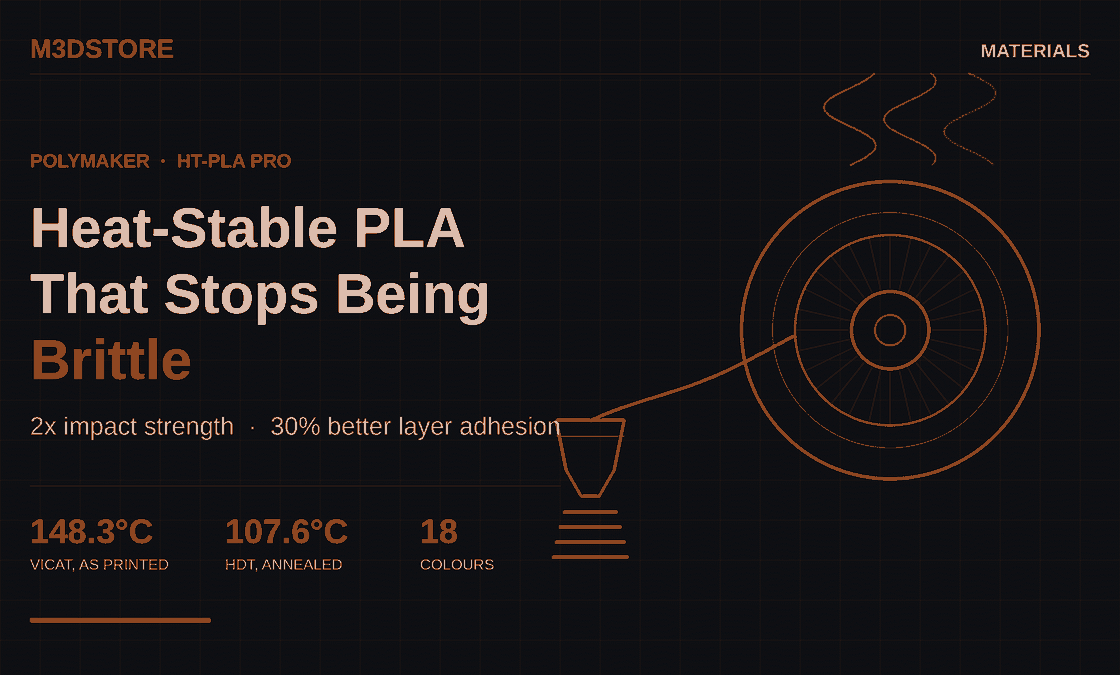
Key takeaways
- Polymaker has launched HT-PLA Pro, a heat-stable PLA aimed at the one thing high-temperature PLA has always been bad at: surviving impacts.
- Against standard HT-PLA it claims more than double the notched Charpy impact strength (9.94 kJ/m² vs 4.94 kJ/m²) and roughly 30% stronger layer adhesion, with Z-tensile rising from 20.8 MPa to 26.8 MPa.
- Heat performance is unchanged from the HT-PLA family: 148.3°C Vicat as printed, 150.5°C after annealing, and a 107.6°C heat deflection temperature at 0.45 MPa after a 30-minute anneal at 100°C.
- It still prints like PLA — no enclosure, no hardened nozzle, 230°C nozzle, 25–65°C bed, validated to 300 mm/s.
- Available now in 18 colours at €25.99 / $25.99 per spool.
Polymaker has released HT-PLA Pro, a new high-temperature PLA that is explicitly pitched at fixing the material class’s weakest link. High-temp PLA solved the “my print sagged in a hot car” problem, but it did so by making an already brittle polymer more brittle. HT-PLA Pro is Polymaker’s attempt to keep the heat resistance and get the toughness back.
What Polymaker actually changed
The company says HT-PLA Pro combines two of its existing technologies — nano reinforcement and heat stability — in a single filament, and that it was developed to address the “key limitations of conventional high-temperature PLA,” namely brittleness and poor layer adhesion.
That second point deserves attention. Layer adhesion is the failure mode that quietly ruins functional parts: a bracket that looks fine on the bed splits along a layer line the first time it gets loaded off-axis. Polymaker quotes Z-tensile strength climbing from 20.8 MPa to 26.8 MPa versus regular HT-PLA — around a 30% improvement in the direction that usually breaks first.
“HT-PLA Pro gives makers, print farms and functional-part users a stronger, more dependable HT-PLA option without adding complexity to their workflow.”
Maarten Bosters, Product Marketing Manager, Polymaker
The numbers that matter
On heat, HT-PLA Pro holds the line rather than pushing it. Vicat softening temperature is 148.3°C as printed and 150.5°C after annealing, measured to ISO 306. After a 30-minute anneal at 100°C, heat deflection temperature reaches 107.6°C at 0.45 MPa, measured to ISO 75. Those are HT-PLA-family figures — the gain here is mechanical, not thermal.
On toughness, notched Charpy impact strength is listed at 9.94 kJ/m² against 4.94 kJ/m² for standard HT-PLA. Slightly more than double, in other words, from a material that prints on the same profile.
Why the repeat-impact test matters more than the spec sheet
Spec-sheet impact figures measure a single hit. Real parts usually die from repeated ones. Polymaker’s Luke Taylor built a rig that drives a carriage into a steel target over and over until the printed bumper breaks away, with the option to circulate boiling water through pipes to heat-soak the sample — a setup covered in detail by Fabbaloo.
At room temperature, impacts-to-failure came in at 432 for plain PLA, 810 for HT-PLA, 1,709 for PLA Pro and 3,157 for HT-PLA Pro. HT-PLA-GF, the glass-filled variant, managed just 35.
Heated, the ranking got more interesting. HT-PLA Pro reached 864 impacts. ABS managed 161 — worse than plain PLA’s 162 — while PETG hit 261 and polycarbonate 456. Only PA12 nylon went further, passing 6,000 before the test was stopped, and it deformed enough during the run to shed bearings. If you have been reaching for ABS because it “handles heat better,” this is a result worth sitting with.
It still prints like PLA — that is the whole point
None of this would matter much if the material demanded a chamber and a tool change. It does not. HT-PLA Pro runs on standard FDM machines without an enclosure or a hardened nozzle, using familiar PLA-style settings: a 230°C nozzle and a 25–65°C build plate, validated for speeds up to 300 mm/s.
The one workflow wrinkle is annealing. The headline heat-deflection number depends on a 30-minute post-print bake at 100°C, so parts that need genuine thermal margin still need that step — and you should expect the usual small dimensional shift that comes with it.
Where it fits on your filament shelf
At €25.99 / $25.99 in 18 colours, HT-PLA Pro is priced like a premium PLA rather than an engineering polymer. For print farms and anyone producing functional parts on open-frame machines, the pitch is straightforward: one material that covers most of what you would otherwise split between PLA, PETG and ABS, without changing the profile or buying a chamber. It is not going to displace nylon or polycarbonate where you truly need them — but it does narrow the list of jobs that require them.
FAQ
Do I need an enclosure or a hardened nozzle for HT-PLA Pro?
No. Polymaker states HT-PLA Pro prints on standard FDM printers without an enclosure or a hardened nozzle, at a 230°C nozzle temperature and a 25–65°C build plate.
How heat resistant is HT-PLA Pro, really?
Vicat softening temperature is 148.3°C as printed and 150.5°C annealed (ISO 306). Heat deflection temperature is 107.6°C at 0.45 MPa (ISO 75) after a 30-minute anneal at 100°C. Without annealing, expect less thermal margin.
Is HT-PLA Pro better than ABS or PETG?
In Polymaker’s own heated repeat-impact test it outlasted both — 864 impacts versus 161 for ABS and 261 for PETG. That is a single manufacturer test on one geometry, so treat it as indicative rather than definitive, but the margin is large.
How much does it cost and what colours are available?
HT-PLA Pro launches in 18 colours at an MSRP of €25.99 / $25.99 per spool.
Related reading
More on picking the right filament: PLA vs PETG vs ABS: Which 3D Printing Filament Should You Use? and PETG vs ABS: Which Filament Should You Use? (2026).
Sources: TCT Magazine, Fabbaloo, Polymaker Wiki.

M3Dstore
Writer at M3D — exploring how 3D printing changes the way we learn, make and live.
Leave a Reply